


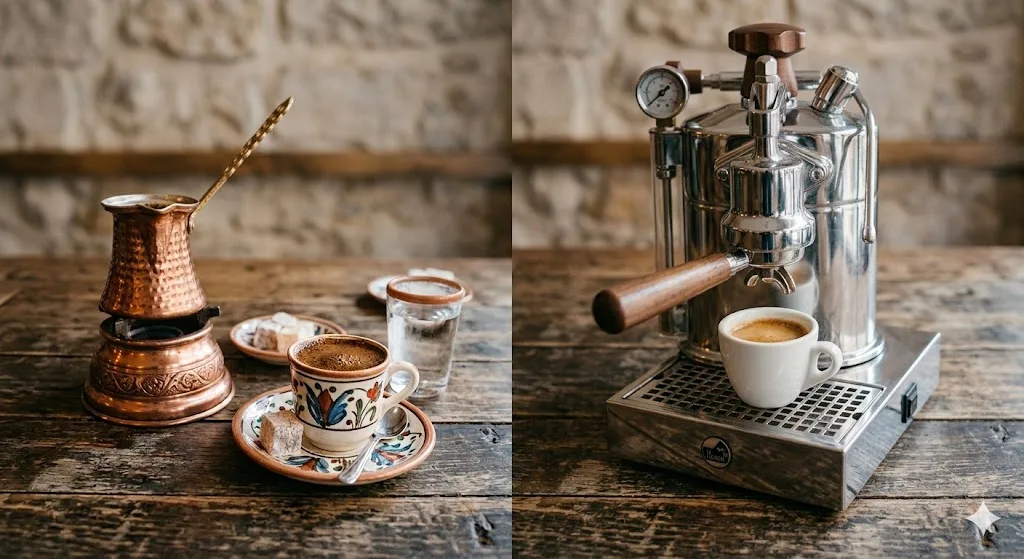
Both are small, dark, and pack a punch, but they represent fundamentally different ideas about what coffee should be. Espresso is engineered concentration. Turkish coffee is patient ritual. One was built for speed; the other was built for conversation.
Here is how they actually compare.
The Quick Comparison
| Category | Turkish Coffee | Espresso |
|---|---|---|
| Grind | Finer than flour | Fine, like table salt |
| Method | Slow simmer in a cezve | 9 bars of pressure, 25-30 seconds |
| Filtration | None; grounds settle in the cup | Filtered through a puck |
| Texture | Velvety, with foam (köpük) on top | Syrupy, with crema |
| Flavor | Earthy, bittersweet, complex | Bright, acidic, bean-forward |
| Caffeine | About 50-60mg per 2-3oz serving | About 60-65mg per 1oz shot |
| Equipment | $20 cezve and heat | $500+ machine and grinder |
| Time to Drink | 15-20 minutes | 2-3 sips |
| Origin | 16th-century Ottoman Empire | 20th-century Italy |
What Makes Turkish Coffee Different
The grind is the secret. Turkish coffee uses the finest grind in the entire coffee world, so fine you cannot feel grit between your fingers. This is not a stylistic choice; it is what allows the unfiltered brewing method to work. The grounds stay suspended, releasing flavor compounds that espresso's pressure extraction simply leaves behind.
The result is a cup with more depth and a lingering finish. Espresso hits hard and disappears. Turkish coffee unfolds slowly: bittersweet on the first sip, chocolatey in the middle, earthy on the way out.
Why the Foam Matters
In Turkish coffee culture, the foam, köpük, is everything. There is a saying: "Köpüksüz kahve, kahve değildir." Coffee without foam is not coffee.
It is not just aesthetic. The foam is a verdict on the brew. A thick, even layer of microfoam tells you the coffee was made correctly: ground fine enough, heated slowly enough, and never allowed to boil aggressively. If the foam is thin, broken, or absent, the coffee was rushed.
The foam also does real work in the cup. It acts as a seal, trapping aromatic oils and carbon dioxide underneath so the first sip carries the full intensity of the brew. Without it, those volatile compounds escape into the air before they reach you. That is why a foamless Turkish coffee tastes flat even when made from the same beans.
There is also tradition: in Turkey and Bosnia, the foam is sometimes spooned into each guest's cup before the coffee is poured, ensuring everyone gets a share.
The Caffeine Myth
People assume Turkish coffee is stronger because of how intense it feels. It is not. Espresso actually has slightly more caffeine per ounce. What Turkish coffee has is presence. The texture, the sediment, the slow sipping alongside water and a small sweet: it occupies you in a way a quick espresso shot never could.
Two Different Answers to the Same Question
Espresso asks: how do we extract the cleanest, most concentrated expression of this bean as fast as possible?
Turkish coffee asks: how do we make coffee a reason to sit down with someone for twenty minutes?
There is an old Turkish saying: "A cup of coffee commits one to forty years of friendship." No one ever said that about an espresso shot.
Both deserve their place. But if you have only ever had espresso, you have experienced one half of what coffee can be.