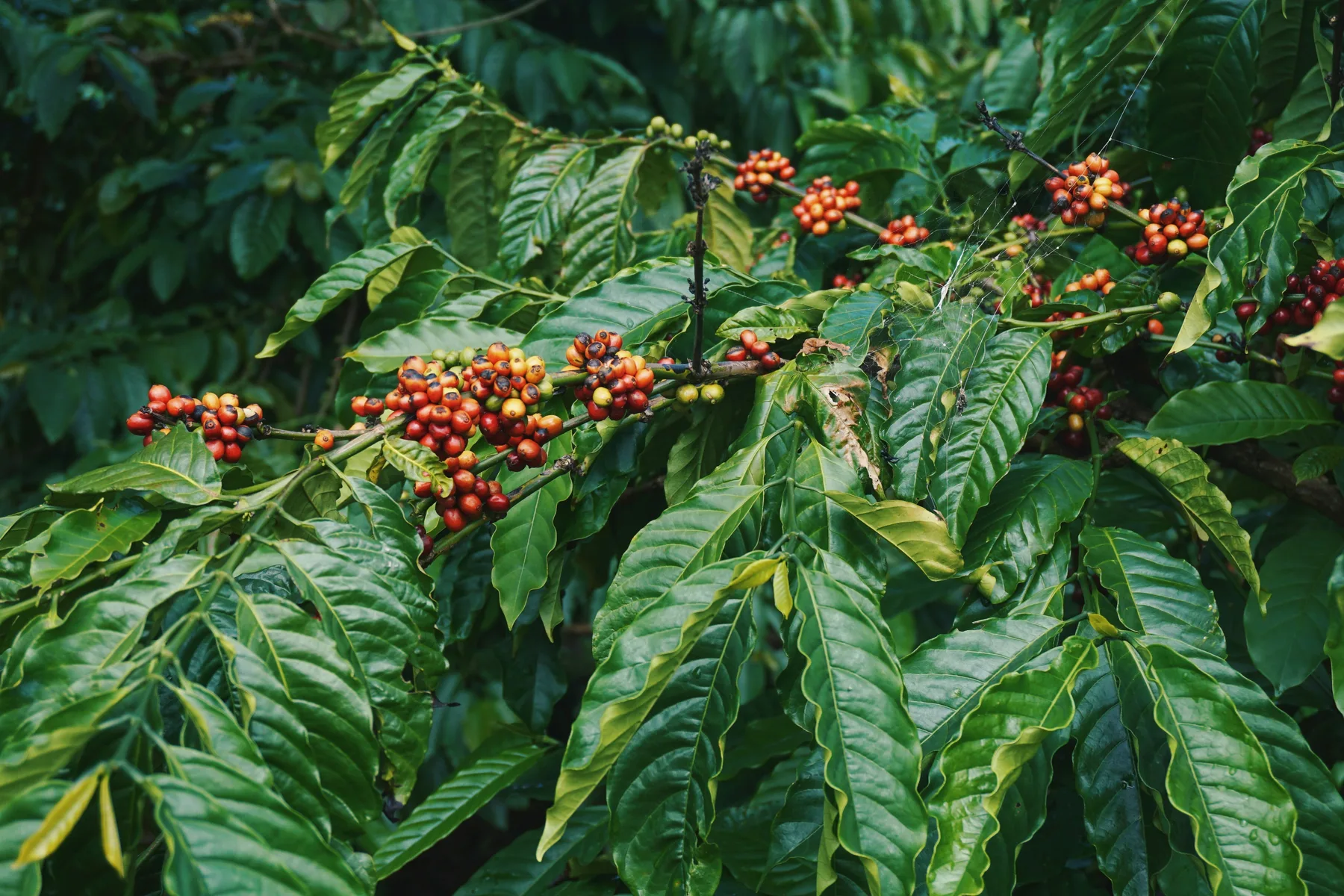
Arabica vs robusta is the difference between two species of coffee plant: arabica grows higher, carries less caffeine and more sugar, and tastes sweeter and more aromatic, while robusta grows lower and hotter, yields more, has roughly twice the caffeine and gives a heavier, earthier cup. Nearly all the coffee in the world is one or the other.
In Part 1 we met the plant. Now meet the family: the two species, side by side, and what two labels on a coffee bag really mean.
What Are Arabica and Robusta?
Both are species in the genus Coffea. Arabica is Coffea arabica, native to the highland forests of southwestern Ethiopia. Robusta is the common name for Coffea canephora, native to central and western sub-Saharan Africa, from Liberia across to Tanzania and Angola.
They are family. Arabica is a natural hybrid of robusta and a third species, Coffea eugenioides.
How Do Arabica and Robusta Compare?
Which Has More Caffeine, Arabica or Robusta?
Robusta, by roughly double. Robusta beans carry about 2.2 to 2.7 percent caffeine by dry weight; arabica about 1.2 to 1.5 percent. So if two cups use the same weight of coffee, the robusta cup has more caffeine. For how that plays out in a small cup, see how much caffeine is in Turkish coffee.
How Do Arabica and Robusta Taste Different?
Arabica has more sugar, about 6 to 9 percent of the bean against robusta's 3 to 7, and more of the compounds that turn into aroma in the roaster. Its cup tends to be sweeter and more aromatic, with acidity that can taste of fruit or flowers, depending on where it grew.
Robusta tastes heavier and earthier, with lower acidity and a fuller body. It has fans of its own: in espresso, a share of robusta gives a thick, lasting crema, which is why some traditional Italian blends include it.

Is Robusta Lower Quality Than Arabica?
Not by definition. Robusta is a different coffee with different strengths. It is hardier, adapts to a wide range of conditions, resists disease well enough to need less pesticide and herbicide, and gives far more coffee per tree. Quality varies within robusta just as it does within arabica, and well-grown, carefully processed robusta has a real place in the cup: good robusta is used in Italian espresso blends for fuller body and a better crema.
Where Do Arabica and Robusta Grow?
Both grow in the tropical belt, but at different heights. Arabica prefers cooler air, averaging roughly 15 to 24 °C, and does best at altitude, ideally around 1,200 to 1,500 meters, though farms run from near sea level to 2,800 meters. Cool nights slow its ripening, which builds sugar and acidity. Robusta takes the heat and is usually farmed lower, from near sea level up to about 600 meters, and it resists disease better, so it needs less spraying and yields more coffee per tree.
Brazil grows large amounts of both; Vietnam grows the largest share of the world's robusta. Part 3 walks the whole coffee belt, region by region.
Why Is Arabica More Expensive Than Robusta?
Mostly because it is harder to grow. Arabica needs altitude and a mild climate, is more vulnerable to pests and disease, and yields less per tree. Robusta is sturdier and more productive.
What Does "100% Arabica" Mean?
It means every bean in the bag is arabica, with no robusta blended in. That is useful to know, but it describes the species, not the quality. Arabica can be ordinary or extraordinary depending on where it grew, how it was picked and processed, and how it was roasted. A bag of 100% arabica can still be any grade.
What Does "Specialty Grade" Mean?
Specialty grade is a quality score, and it is much harder to earn than a species label. Trained tasters called cuppers score coffee out of 100 using the Specialty Coffee Association's cupping form, judging aroma, flavor, aftertaste, acidity, body, balance and more. Coffee that scores 80 points or more, with very few defects in the unroasted beans, counts as specialty.
- 80 to 84.99: very good
- 85 to 89.99: excellent
- 90 and above: outstanding
So "specialty-grade arabica" tells you two things at once: the species, and that the beans cleared the bar.
Our Whole Bean Traditional Coffee brings two specialty-grade arabicas together: a rich one roasted dark and a bright one roasted lighter. Grind it to suit your espresso machine, moka pot, drip brewer or French press. Our guide to light vs dark roast explains why the two get different roasts.
Which Should You Choose for Turkish Coffee?
Turkish coffee is ground powder-fine and served unfiltered, so the bean reaches the cup with nothing in between. That rewards sweetness and aroma, which is why most Turkish coffee lovers choose arabica, and why specialty grade makes a visible difference in a small cup.
For Turkish coffee, grind the whole beans with a grinder capable of a true powder-fine setting, finer than espresso. Or choose Traditional Turkish Coffee, the same blend already ground powder-fine.
Arabica vs Robusta FAQ
What is the difference between arabica and robusta?
They are two different species of coffee plant. Arabica (Coffea arabica) grows higher, has less caffeine and more sugar, and tastes sweeter and more aromatic. Robusta (Coffea canephora) grows lower and hotter, resists disease, yields more, has about twice the caffeine, and gives a heavier, earthier cup.
Does robusta have more caffeine than arabica?
Yes, roughly twice as much: about 2.2 to 2.7 percent of the bean by weight for robusta, against about 1.2 to 1.5 percent for arabica.
Which is more popular, arabica or robusta?
Arabica is the larger share of world production, with robusta making up most of the rest. Vietnam is the largest robusta producer; Brazil grows large amounts of both.
What does "100% arabica" mean?
It means every bean in the bag is from the arabica species, with no robusta mixed in. It tells you the species, not the grade: 100% arabica can be ordinary or exceptional.
What does specialty grade mean?
Specialty coffee is coffee that scores 80 points or more out of 100 on the Specialty Coffee Association cupping scale, with very few defects in the unroasted beans. 80 to 84.99 is graded very good, 85 to 89.99 excellent, and 90 and above outstanding.
Why do some espresso blends use robusta?
Robusta adds body and a thick, lasting crema, and a little goes a long way. That is why some traditional Italian espresso blends include it.