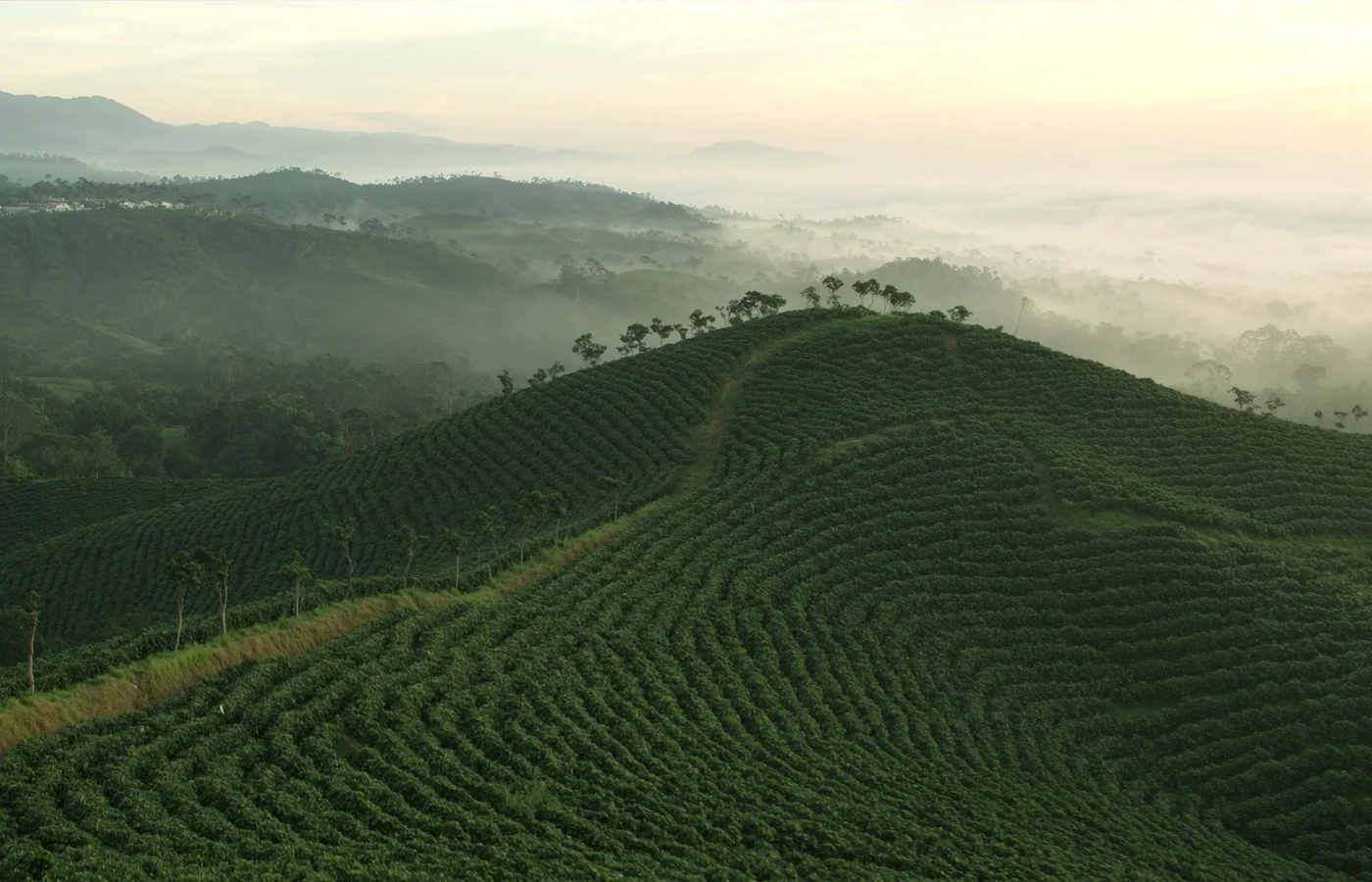
Brazilian coffee is coffee from the world's largest producer: Brazil grows about a third of all the coffee on earth, mostly on wide, rolling plateaus, and its classic cup is smooth, full-bodied and low in acidity, with notes of chocolate and nuts. That profile is why Brazilian coffee sits at the base of so many blends and espressos.
This guide covers how Brazil became the giant of coffee, where it grows, how its coffee is processed, what it tastes like, and why roasters reach for it when they build a blend.
How Much of the World's Coffee Comes From Brazil?
About a third of it. Brazil has been the world's largest coffee producer for roughly 150 years, and today it grows more than the next several producers combined. The plant came late, though. The traditional story is that the first coffee bush was planted in 1727, in the northern state of Pará, by Francisco de Melo Palheta, from seeds said to have been smuggled out of French Guiana. Within a century and a half, the country was supplying much of the world's cup.
Brazil grows both main species. Roughly 70 percent of its coffee is arabica and about 30 percent is robusta, which Brazilians call conilon. Our guide to arabica vs robusta explains the difference between the two.
Where Is Coffee Grown in Brazil?
Most of it grows in the southeast. Three states lead:
Minas Gerais is the heart of Brazilian arabica, with more than a million hectares of coffee. Its best-known regions include Sul de Minas, averaging about 950 meters, and the Cerrado Mineiro, a high plateau at roughly 800 to 1,300 meters with clear wet and dry seasons.
Espírito Santo grows most of Brazil's conilon (robusta) in its lowlands, with arabica in its mountains.
São Paulo is the third of the big three, with more than 200,000 hectares of coffee.

Why Does Altitude Matter for Brazilian Coffee?
Compared with the mountain coffees of East Africa or the Andes, much of Brazil's arabica grows lower, on broad plateaus rather than steep slopes. Lower altitude means warmer nights and faster ripening, and faster ripening tends to build less acidity into the bean. The result is the classic Brazilian profile: soft acidity, plenty of body and sweetness. Our coffee origins guide shows how altitude shapes coffee from every growing region.
The flat terrain matters in another way, too. Highland plateaus like these are open enough for machines, which steep mountain farms elsewhere cannot use. The main harvest comes once a year, in the dry season, roughly June through September.
How Is Brazilian Coffee Processed?
Brazil is known for drying its coffee in the fruit.
Natural (dry process). The whole cherry is spread out to dry in the sun, then the dried fruit is hulled away. Brazil is unusual among large producers in that most of its coffee is processed this way. Drying inside the fruit tends to add sweetness and body and soften the acidity.
Pulped natural. A method developed in Brazil. The cherry skin is removed, but the beans dry with the sticky fruit layer, the mucilage, still on them. It uses less water than full washing and sits between the two styles, with the sweetness and body of a natural and some of the clarity of a washed coffee. Many specialty Brazilian lots are pulped natural.
Washed. Less common in Brazil, but some farms remove all the fruit before drying for a cleaner, brighter cup.
How Long Does Brazilian Coffee Take to Dry?
On a typical farm, natural coffee is spread out on open patios and dried in the sun for about eight to ten days, turned through the day so it dries evenly. Once dry, the fruit and husk are hulled away, and the unroasted beans are sorted by size and quality and packed in 60-kilogram sacks, the standard bag the coffee trade still uses to count the world's harvest.
Drying is where much of the flavor of a natural coffee is decided. Dried slowly and evenly, the fruit lends its sugars to the bean, and the cup comes out sweet and round. That patient step is one reason good Brazilian naturals taste so smooth.
What Does Brazilian Coffee Taste Like?
The classic Brazilian cup is smooth and full-bodied, with low acidity and notes of chocolate, nuts and caramel. It is the flavor many people picture when they think of coffee. Regions add their own accents: some Sul de Minas coffees bring a gentle citrus note and fruity aroma, and some Cerrado lots a little more acidity.
That profile makes Brazilian coffee forgiving. It holds up well to a darker roast, where its chocolate notes deepen rather than fade, and it is easy to drink black.
Why Is Brazilian Coffee a Classic Base for Blends and Espresso?
A good blend needs a base and an accent. The base gives the cup body, sweetness and a steady foundation; the accent brings aroma and brightness. Brazilian coffee is one of the most common bases there is. Its body and low acidity carry a dark roast, it gives an espresso shot weight and a thick crema, and it leaves room for a brighter coffee to sit on top.
The same logic works in a Turkish cup. Turkish coffee is ground powder-fine and served unfiltered, so the base coffee decides how much body the cup has and how well the foam holds. A rich, low-acidity coffee roasted darker gives depth and a sturdy foam; a bright coffee roasted lighter gives aroma. Our guide to Ethiopian coffee covers the bright side of that pairing.
Our coffee origins guide lets you try this yourself: pick a base, pick an accent, and see how the blend balances. A cup built on two bases tends to taste heavy and flat; a cup of two accents can taste thin and sharp. One of each is the classic structure, and it is why a coffee with Brazil's profile appears in so many blends on so many shelves.

Which Coffee Should You Try for Turkish Coffee?
Ours. Lezzet Traditional is built on Brazil, with Ethiopia alongside it.
To see how other origins play the base or the accent, open the coffee origins guide, or read why roasters treat light vs dark roast as a choice per coffee.
Brazilian Coffee FAQ
Is Brazil the largest coffee producer in the world?
Yes, by a wide margin. Brazil grows about a third of the world's coffee and has been the largest producer for roughly 150 years.
What does Brazilian coffee taste like?
Typically smooth and full-bodied, with low acidity and notes of chocolate, nuts and caramel. Higher-grown and specialty lots can add fruit and a gentle citrus lift.
Does Brazil grow arabica or robusta?
Both. Roughly 70 percent of Brazil's coffee is arabica, grown mainly in Minas Gerais and São Paulo, and about 30 percent is robusta, which Brazilians call conilon, grown mainly in Espírito Santo.
What is pulped natural coffee?
A method developed in Brazil: the cherry skin is removed, but the beans dry with the sticky fruit layer, called mucilage, still on them. It sits between washed and natural coffee, and tends to give sweetness, body and balance.
Why is Brazilian coffee used in espresso blends?
Its body, sweetness and low acidity make a steady base. It carries a dark roast well, gives a shot weight and crema, and leaves room for a brighter coffee to add aroma on top.
Is Brazilian coffee good for Turkish coffee?
A rich, low-acidity coffee like a classic Brazilian gives a Turkish cup body and a sturdy foam. Many Turkish coffee blends pair a coffee like that with a brighter one for aroma.