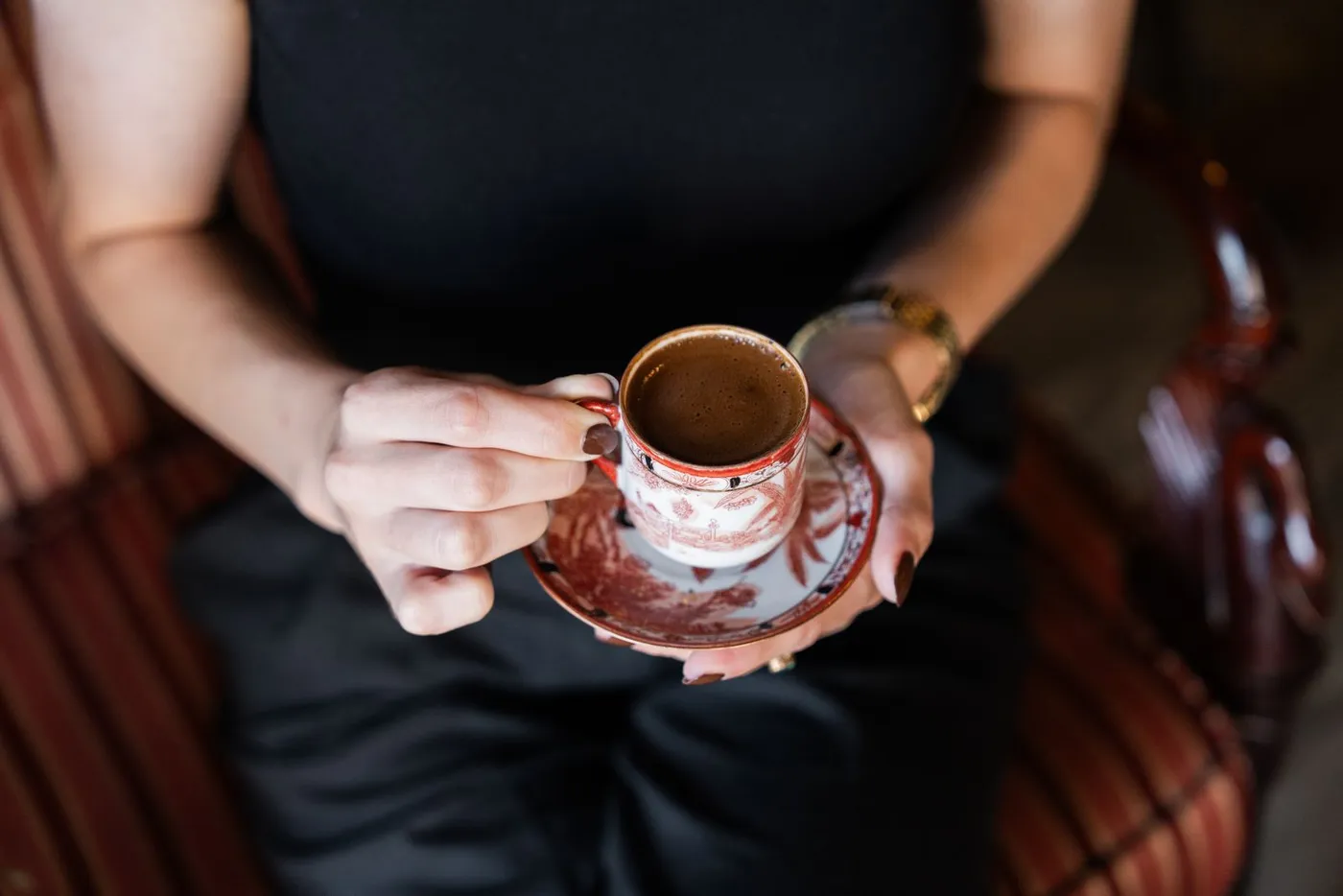
The cup is not new here. What is new is how many people are ready for it. This is the American story in two halves: where Turkish coffee was poured first, and what has changed in the last few years.
The First Cups: America's World's Fairs
The Ottoman Empire sent carpets and a café to the 1876 Centennial Exhibition in Philadelphia, the first official world's fair held in the United States. A watercolor from that October in the Historical Society of Pennsylvania shows the "Turkish Café and Bazaar": a small, brightly painted building topped with a star and crescent, standing in Fairmount Park opposite Machinery Hall. The National Park Service's account of the fair lists the Turkish Coffee House among the restaurants built to suit visitors' tastes.
Seventeen years later, the 1893 World's Columbian Exposition in Chicago put a Turkish Village on its Midway, with a theater, a mosque and a bazaar. A period account describes coffee served there to favored guests, among the rugs and carpets for sale.
Little Syria: Turkish Coffee on Washington Street
From the 1880s, immigrants from Ottoman-ruled Syria and Lebanon settled along Washington Street in Lower Manhattan, from Battery Place up toward Rector Street. The neighborhood, Little Syria, was the center of Arab American life until the 1940s, and its cafés were the center of the neighborhood: men played backgammon, smoked water pipes and drank thick coffee, made the same way at home, where many called it Arabic coffee.
Sahadi's opened on Washington Street in 1895 and is still in business, now on Atlantic Avenue in Brooklyn. The Lebanon Restaurant, opened in 1920, served shish kebab, baklava and thick Turkish coffee. Most of the neighborhood was cleared in the 1940s for the Brooklyn-Battery Tunnel, and the coffee moved with the families.

Kept Alive at Home
For most of the twentieth century, Turkish coffee in America was a family affair. Greek families brewed Greek coffee in a briki and ordered it by sugar; Armenian households made Armenian coffee in a jazzve and read the cups afterward; Bosnian families who arrived in the 1990s brought the džezva and the sugar cube. Turkish, Lebanese and Syrian families did the same. The grocers that served them, from Atlantic Avenue to Dearborn, kept the imported bags on the shelf.
It was the same powder-fine cup under five names, passed down rather than marketed. Our guide to Turkish, Greek and Arabic coffee history follows how one method picked up all of them.
Why Turkish Coffee Is Growing Now
American adults drink coffee each week (NCA, Spring 2026).
of past-day coffee drinkers had coffee made at home.
of American adults had specialty coffee in the past week.
growth in past-day specialty coffee drinking since 2011.
Americans make coffee at home. The National Coffee Association's Spring 2026 data puts weekly coffee drinkers at nearly 195 million adults, and 82% of people who had coffee yesterday had it prepared at home. Turkish coffee is one of the few methods that needs no machine at all: a small pot, a stove and a few minutes.
Specialty coffee trained the palate. The NCA found 58% of American adults had specialty coffee in the past week in Spring 2026, and its 2025 Specialty Coffee Report put past-day specialty drinking up 84% since 2011. People who now ask about grind size and roast dates are ready for a method that lives or dies on both.
The table went global. Datassential's 2025 trends report named "Next-Gen Coffee", global coffee traditions arriving stateside, as a theme. Turkish coffee arrives with more than a taste: the cezve, the foam, the cardamom, the lokum and a game of reading the grounds afterward.
What Still Holds It Back
Mostly, not knowing how. Do you drink the grounds? (No: they settle and stay in the cup.) Why is it ground so fine? (There is no filter, so the grind has to sink on its own.) Does it need special equipment? (A small pot, or the smallest saucepan you own.) Each answer is short, and once someone has made one cup, the questions are gone. Our introduction to Turkish coffee answers the rest, and how to make Turkish coffee covers the cup step by step.
Where Lezzet Fits
For most of its American history, Turkish coffee arrived here already roasted and already ground, after months at sea and on shelves. Powder-fine coffee loses its aroma faster than any other grind, so the first thing we changed was the distance. Lezzet is specialty-grade coffee, fresh-roasted in the USA in small batches and ground powder-fine for the cezve, so the cup that families kept alive for 150 years reaches your cezve fresh.
Turkish Coffee in America: FAQ
When did Turkish coffee come to America?
At least by 1876, when a Turkish café was part of the Centennial Exhibition in Philadelphia. From the 1880s, immigrants from the Ottoman lands brewed it at home and in coffeehouses, most famously in Little Syria on Manhattan's Washington Street.
Is Turkish coffee popular in the United States?
It is still a niche, but a growing one. Most Americans now make coffee at home and more than half drink specialty coffee each week, and Turkish coffee fits both: it needs only a small pot, and it rewards good, fresh beans.
Where can you buy Turkish coffee in America?
Middle Eastern, Greek, Balkan and Turkish grocers carry imported brands, and a few roasters in the US now make it fresh. Lezzet is one: specialty-grade coffee, fresh-roasted in the USA in small batches and ground powder-fine for the cezve.