Turkish coffee is often described through the cup: the cezve, the foam, the small serving, and the grounds that settle at the bottom. But before it became a ritual, it was cargo.
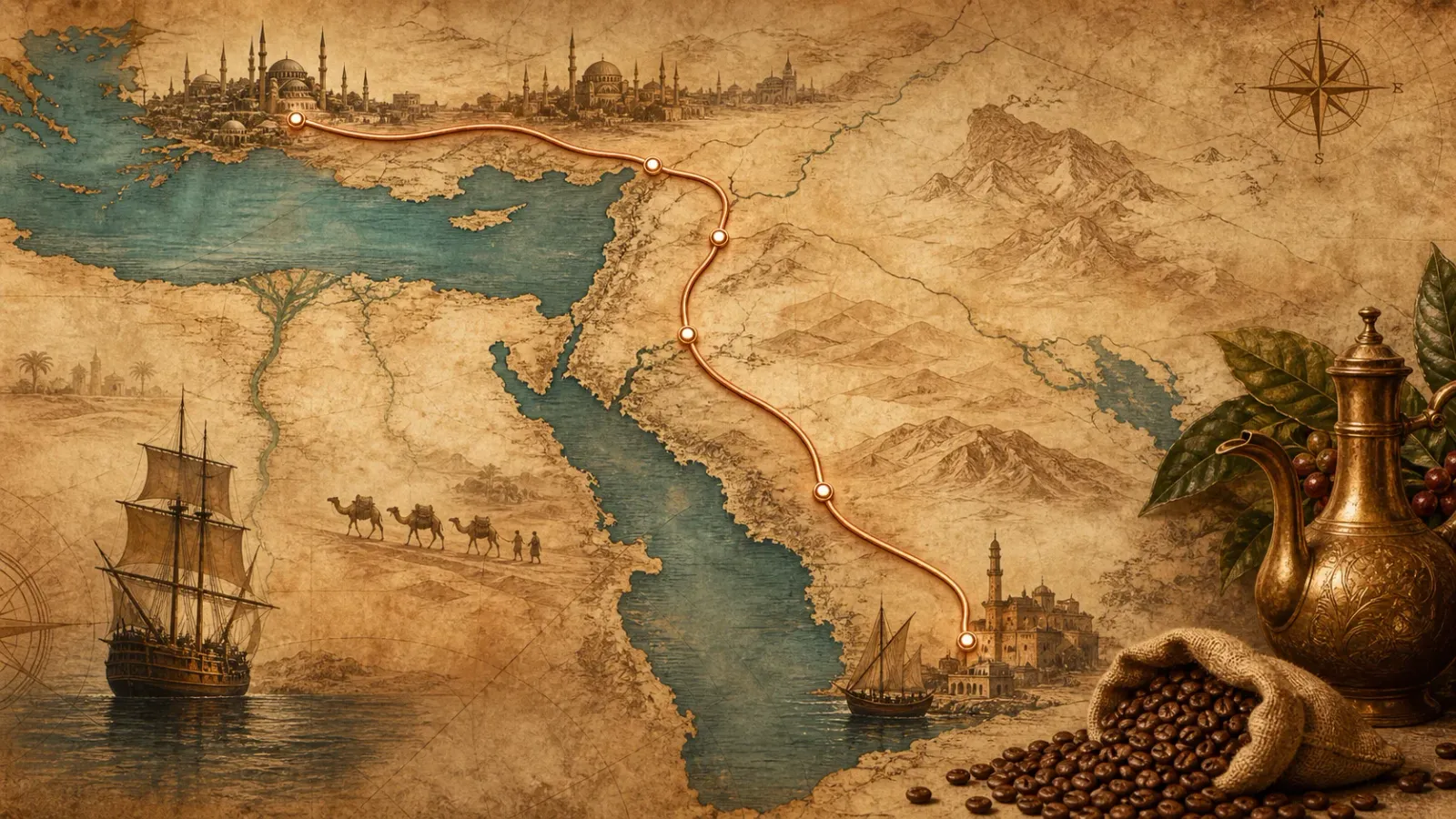
During the Ottoman era, coffee moved through one of the most important trade corridors in the early modern world. Beans grown in Yemen traveled by caravan and ship through Mocha, Aden, the Red Sea, Egypt, Syria, and Istanbul. By the time coffee reached Ottoman coffeehouses, it had already passed through farmers, port brokers, ship captains, tax officials, merchants, and roasters.
Yemen highlands
Coffee was cultivated inland, then moved toward port cities by regional merchants and caravans.
Mocha and Aden
Yemeni Red Sea ports became export gates for coffee headed into Ottoman, Middle Eastern, Indian Ocean, and European markets.
Jeddah and the Red Sea
Ships carried coffee north through the Red Sea corridor, a route already shaped by pilgrimage, spice, textile, and Indian Ocean trade.
Suez, Cairo, and Egypt
Egypt acted as a major sorting and redistribution point before coffee continued toward Syria, Anatolia, and the Mediterranean.
Damascus, Aleppo, and Istanbul
Coffee entered Ottoman urban life through commercial cities, merchants, coffeehouses, and palace culture.
The Route Started in Yemen
Coffee's botanical story points toward the Ethiopian highlands, but the early commercial coffee story runs strongly through Yemen. Yemeni highlands proved suitable for cultivating coffee, and by the fifteenth and sixteenth centuries coffee had become part of religious, social, and commercial life in the region.
JSTOR Daily summarizes the early pattern: Yemeni Sufis were using coffee by at least the mid-1400s, and by the sixteenth century the drink and the beans had moved beyond Yemen into a wider Islamic and Ottoman world.

Mocha Was More Than a Name
Today, many people hear "mocha" and think chocolate. Historically, Mocha, also spelled al-Mukha or Mokha, was a port on Yemen's Red Sea coast and one of the names that carried coffee into the world.
Britannica describes Mocha as Arabia's chief coffee-exporting center, noting that the term "mocha" entered European languages as a synonym for high-quality Arabica coffee formerly exported through the town. Coffee was Mocha's chief export for European and Middle Eastern markets from the fifteenth century.
That is why the old meaning of mocha matters. Before it meant a sweet cafe drink, it meant a coffee geography: Yemen, Red Sea trade, and beans moving outward through a port city.
The Red Sea Was Coffee's Highway
The route from Yemen to the Ottoman heartlands depended on the Red Sea. Coffee could move from Yemeni ports north toward Jeddah, then toward Suez and Egypt. From there it could be sorted, taxed, bought, sold, and redistributed toward Cairo, Damascus, Aleppo, Istanbul, and Mediterranean markets.
This was not a coffee-only route. It overlapped with older networks for spices, textiles, aromatics, metals, pilgrimage traffic, and Indian Ocean trade. Coffee joined an already busy commercial system, then became important enough to reshape parts of that system around itself.
Ottoman Control Was Powerful, but Complicated
The Ottoman Empire conquered Yemen's coastal region in the sixteenth century, partly in the context of Red Sea and Indian Ocean competition. But controlling a coast was different from controlling the rugged highlands where coffee was grown.
JSTOR Daily's discussion of Jane Hathaway's research notes that the Ottomans controlled the Yemeni coffee trade through ports such as Aden and Mocha, but inland politics, tribal divisions, and resistance made the trade difficult to govern completely. The Ottomans were forced to leave Mocha in 1636, though coffee continued moving through Ottoman and Egyptian commercial hands after that.
That makes the coffee trade more interesting than a simple empire story. Coffee moved through Ottoman power, but also through Yemeni growers, local rulers, Egyptian merchants, Arab brokers, Indian Ocean traders, and European companies.
Mocha Was an Indian Ocean Port, Not Just an Ottoman Outpost
Mocha sat at the edge of several worlds. It faced the Red Sea, but it was also tied to the Indian Ocean. Indian traders, Egyptian merchants, European companies, and local Yemeni commercial families all used the port.
Architectural historian Nancy Um describes Mocha as one of the most important Red Sea ports of the early modern Arab world, handling coffee beans along with spices, textiles, metals, and aromatics. Her research on Mocha's commercial architecture also shows that trade often happened through merchant houses rather than only through formal public market buildings.
That detail changes how we imagine the route. Coffee was not simply unloaded in a warehouse and sent away. Deals happened in homes, courtyards, lodgings, and merchant networks shaped by trust, language, family, and credit.
Egypt Turned Coffee Into an Ottoman Commodity
Egypt was one of the most important middle points in the coffee route. Coffee that moved north through the Red Sea could enter Egyptian markets before continuing toward Syria, Anatolia, and Istanbul. Cairo was not just a stop; it was a major commercial and cultural filter.
In practical terms, Egypt helped convert Yemeni coffee into a wider Ottoman commodity. Beans could be gathered, priced, taxed, redirected, and moved onward. That is one reason Turkish coffee culture cannot be separated from the wider Ottoman world. The cup in Istanbul had a route behind it.
Damascus, Aleppo, and Istanbul Spread the Habit
By the mid-sixteenth century, coffee had reached Istanbul and became part of urban life. The exact first coffeehouse date varies by source, but Ottoman chronicler Ibrahim Pecevi is commonly cited for the story that Hakem from Aleppo and Sems from Damascus opened a coffeehouse in Istanbul's Tahtakale district around 1554.
This detail is important because it shows the human side of the route. Coffee did not arrive in Istanbul as an abstract good. It arrived through people from Syrian commercial cities who understood both the product and the culture around serving it.

Coffeehouses Turned Trade Into Culture
Once coffee entered Ottoman cities, the route changed form. Beans were roasted, brewed, and poured, and the cup itself became a reason to gather — a place to talk, argue, read, and do business.
Ottoman coffeehouses were not only beverage shops. They were social infrastructure. A trade route delivered coffee, but the coffeehouse turned it into habit. That is how a bean from Yemen became part of daily life in Istanbul, Damascus, Cairo, and beyond.
Europe Met Coffee Through Ottoman and Red Sea Networks
European merchants did not invent the early coffee trade. They entered an existing Red Sea and Ottoman commercial world. Britannica notes that British, Dutch, Danish, and French trading establishments operated in Mocha at different points, and that conflicts between European powers, the Ottoman Empire, and Yemeni rulers contributed to Mocha's later decline.
By the eighteenth century, Dutch coffee plantations in Java and the rise of coffee production elsewhere began to weaken Mocha's central role. But the name remained. So did the association between coffee, Ottoman culture, Yemen, and the Red Sea.
The Full Timeline: From an Ethiopian Hillside to Today
Zoom out from the trade route, and the story of Turkish coffee spans more than a thousand years. Here is the short version of how a berry from the Ethiopian highlands became one of the world's most enduring brewing traditions.
The Ethiopian origins
Coffee grows wild in the Ethiopian highlands. The famous story of Kaldi, a goat herder whose goats grew lively after eating red berries, is a legend first written down in 1671; nobody knows who brewed the first cup.
The Yemeni connection
Coffee crossed the Red Sea to Yemen, where Sufi monks in Mocha cultivated the plant and developed early roasting and brewing methods. Yemen became the world's first coffee exporter — the starting point of the trade route above.
The Ottoman innovation
When coffee reached Istanbul in the mid-1500s, the Ottomans transformed it: beans ground to an ultra-fine powder, brewed slowly in a small copper cezve — fine coffee, cold water, low heat, no filter. The first coffeehouses (kahvehane) opened around 1554, nicknamed "schools of the wise" for the talk inside, and became such charged centers of debate that Sultan Murad IV tried to ban them in the 1630s. The ban did not last. The method has not fundamentally changed since.
The European spread
Ottoman envoys and merchants carried the drink to European courts, and many early European coffeehouses took the kahvehane as their model. Armenian merchants opened some of the first: in Paris in 1672 and Vienna's first in 1685. Vienna also tells a famous story about sacks of beans left behind after the 1683 siege, though historians treat it as legend.
A living tradition
Turkish coffee culture covers not just the drink but the hospitality customs around it, from guests always being offered coffee to marriage traditions where the bride prepares the suitor's cup. Today it remains the default cup across Turkey, Greece, the Balkans, the Middle East, and North Africa, and a growing ritual in American homes.

Why the Route Still Matters
The Ottoman coffee route is part of why Turkish coffee carries so much beyond the brewing method. It holds a cultural memory of movement: highland farms, caravan roads, Red Sea ports, merchant houses, Cairo markets, Syrian traders, Istanbul coffeehouses, and family rituals.
That history also explains why Turkish coffee feels different from modern machine coffee. It was shaped before espresso bars, disposable cups, and drive-through windows. Its form comes from a world where coffee was roasted, ground fine, brewed slowly, shared in small cups, and attached to conversation.
Every cup of Turkish coffee still follows that route: Ethiopian highlands, Red Sea ports, Istanbul's coffeehouses, your stove.